The way people consume food is changing fast. Busy lifestyles, urban living, and the growing demand for convenience have pushed ready-to-eat meals into the spotlight. From instant curries and soups to premium pet food and gourmet sauces, consumers now expect products that are safe, long-lasting, and easy to use—without sacrificing quality.
At the center of this transformation is one powerful innovation: the retort pouch.
But what makes this packaging format so effective? And why are high-temperature BOPET (biaxially oriented polyethylene terephthalate) films essential to its performance?
Let’s break it down.
What is a Retort Pouch?
A retort pouch is a flexible, heat-resistant packaging solution designed to hold food that can be sterilized at high temperatures. Unlike traditional cans or glass jars, retort pouch packaging is lightweight, space-efficient, and capable of preserving food for extended periods without refrigeration.
In simple terms, if you’ve ever eaten ready-to-eat meals that last months—or even years—on a shelf, chances are they were packed in a retort pouch.
Why Retort Pouch Packaging is Booming
The global demand for retort pouch packaging is growing rapidly, and for good reason:
- Convenience: Easy to store, open, and consume
- Long Shelf Life: Products can last up to 12–24 months
- Cost Efficiency: Lower transportation and storage costs
- Sustainability: Uses less material compared to rigid packaging
- Enhanced Food Safety: Sterilization eliminates harmful microbes
From military rations to airline meals and supermarket shelves, retort pouches are everywhere.
However, none of this would be possible without the right material technology—specifically, retort-grade BOPET films.
The Role of High-Temperature BOPET Films
Retort processing involves exposing packaged food to temperatures ranging from 121°C to 135°C under pressure. This process effectively kills bacteria, ensuring the food remains safe for consumption over long periods.
But here’s the challenge: not all packaging materials can withstand such extreme conditions.
This is where specialized BOPET films come in.
What Makes BOPET Ideal?
BOPET films offer a combination of properties that make them indispensable in retort pouch packaging:
- High Thermal Stability: Maintains structural integrity even at sterilization temperatures
- Excellent Mechanical Strength: Resists punctures and tears
- Superior Barrier Properties: Protects against moisture, oxygen, and contaminants
- Dimensional Stability: Prevents shrinkage or deformation during processing
- Clarity and Printability: Enhances visual appeal and branding
In short, BOPET acts as the backbone of a retort pouch, ensuring it survives the harsh sterilization process without compromising the food inside.
How Retort Pouches Are Constructed
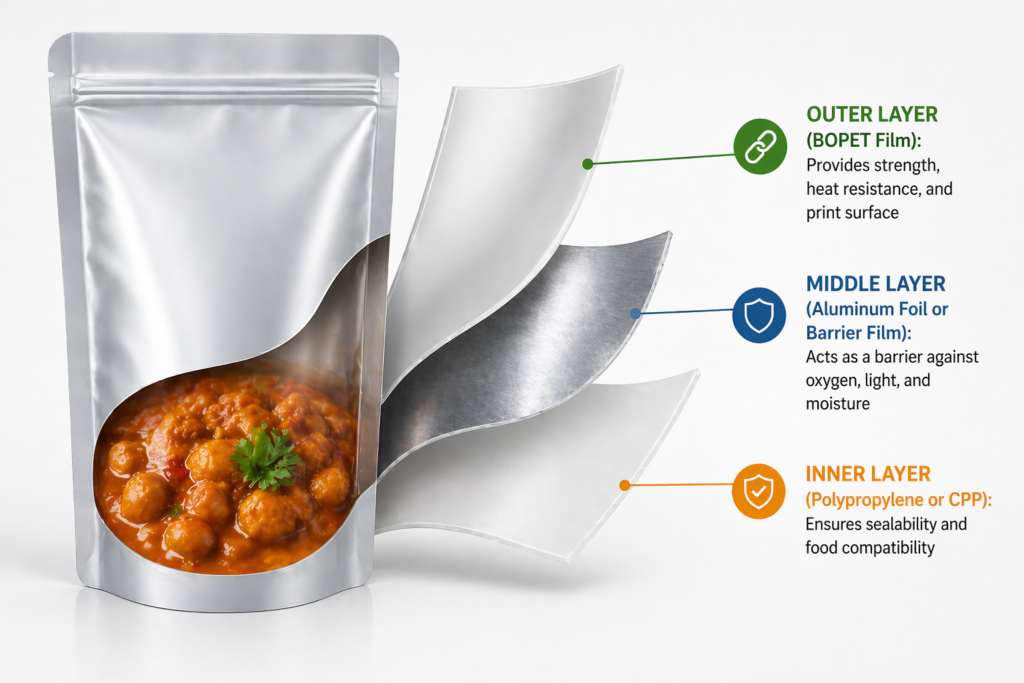
A typical retort pouch is made using a multi-layer laminate structure, where each layer plays a critical role:
- Outer Layer (BOPET Film):
Provides strength, heat resistance, and print surface - Middle Layer (Aluminum Foil or Barrier Film):
Acts as a barrier against oxygen, light, and moisture - Inner Layer (Polypropylene or CPP):
Ensures sealability and food compatibility
Among these, the BOPET layer is crucial, as it must endure the highest stress during retort processing.
Why High-Temperature Resistance Matters
During sterilization, the packaging undergoes:
- High heat (121°C–135°C)
- Pressure changes
- Moisture exposure
If the packaging fails at any stage, it can lead to:
- Leakage
- Contamination
- Reduced shelf life
- Product spoilage
High-performance BOPET films are engineered specifically to handle these conditions. They do not warp, delaminate, or lose strength—even after repeated exposure to extreme temperatures.
This ensures that the retort pouch packaging remains intact, preserving both the food quality and safety.
Applications of Retort Pouches
The versatility of retort pouches has made them a preferred choice across industries:
1. Ready-to-Eat Meals
From Ethnic cuisines to pasta and rice dishes, retort pouches make it easy to enjoy meals anytime, anywhere.
2. Soups and Sauces
Liquid-based foods benefit from the leak-proof and heat-resistant properties of retort packaging.
3. Wet Pet Food
Pet food brands rely heavily on retort pouches for safe, long-lasting storage of nutrient-rich meals.
4. Seafood and Meat Products
High-protein foods require strict sterilization, making retort packaging the preferred choice.
Advantages Over Traditional Packaging
Compared to cans and glass jars, retort pouches offer several advantages:
| Feature | Retort Pouch | Cans | Glass Jars |
|---|---|---|---|
| Weight | Lightweight | Heavy | Very Heavy |
| Storage | Space-saving | Bulky | Bulky |
| Heating | Quick | Slow | Slow |
| Cost | Lower | Moderate | High |
| Sustainability | Better | Moderate | Low |
This shift toward flexible packaging is one of the key reasons why the retort pouch market is growing so rapidly worldwide.
The Tapadia Polyesters Advantage
When it comes to high-performance BOPET films, quality and reliability are non-negotiable. Manufacturers need materials that consistently perform under extreme conditions.
This is where Tapadia Polyesters stands out.
With a strong focus on innovation and quality, Tapadia Polyesters produces advanced BOPET films tailored for demanding applications like retort pouch packaging. Their films are engineered to deliver:
- Consistent heat resistance
- Superior strength and durability
- Reliable performance during sterilization
- Excellent compatibility with multi-layer laminates
By enabling robust packaging solutions, Tapadia Polyesters plays a key role in supporting the growth of the ready-to-eat food industry.
Tapadia Polyester’s Commitment to Certified Solutions
Tapadia Polyester integrates sustainability into every stage of production, backed by advanced manufacturing infrastructure and globally recognized certifications. By offering PET films aligned with EN15343 and ISCC Plus standards, the company ensures:
- Verified and traceable recycled content
- Responsible sourcing practices
- Consistent product performance
- Compliance with global sustainability benchmarks
This allows customers to focus on their own goals, knowing their materials meet the highest standards.
The Future of Retort Packaging
As consumer demand continues to evolve, the future of retort pouch packaging looks promising.
Key trends include:
- Sustainable Materials: Development of recyclable and eco-friendly laminates
- Improved Barrier Technologies: Enhancing shelf life without aluminum layers
- Smart Packaging: Integration of freshness indicators and QR codes
- Premium Branding: High-quality printing and design innovations
At the heart of all these advancements will be high-performance films like BOPET, ensuring that packaging keeps up with both consumer expectations and regulatory standards.
Conclusion
The rise of the retort pouch is no coincidence. It’s a result of advanced material science meeting modern consumer needs.
From ensuring food safety to extending shelf life and improving convenience, retort pouch packaging has transformed the way we store and consume food.
And behind this innovation lies a critical component—high-temperature BOPET films—that make it all possible.
As the demand for ready-to-eat meals continues to grow, companies like Tapadia Polyesters are leading the way by providing reliable, high-quality film solutions that keep food safe, fresh, and accessible.
Connect with Tapadia Polyesters today to discover advanced polyester films designed for the future of flexible packaging
Frequently Asked Questions (FAQs)
A retort pouch is a flexible, heat-resistant packaging used to store food that is sterilized at high temperatures, allowing for long shelf life without refrigeration.
Retort pouches are designed to withstand sterilization temperatures between 121°C and 135°C.
BOPET is used because of its high thermal stability, strength, and barrier properties, making it ideal for high-temperature processing.
Ready-to-eat meals, soups, sauces, baby food, and wet pet food are commonly packaged in retort pouches.
Yes, in many ways. Retort pouches are lighter, more cost-effective, easier to store, and faster to heat compared to traditional cans.