


PET (Polyethylene Terephthalate) bottles are among the most widely used plastic packaging materials globally due to their durability, clarity, lightweight nature, and recyclability. When properly collected and processed, PET can be converted into high-quality recycled materials that serve packaging, textile, automotive, and industrial markets.
This article explains how PET bottles are recycled into high-quality materials that are reused across multiple industries.
Why PET Recycling Matters from a Material Perspective
Recycling PET is not only an environmentally friendly practice; it is also a resource-efficient strategy. PET is derived from petrochemicals, which require energy-intensive extraction and refining. Recycling PET:
- Reduces demand for virgin raw materials
- Lowers energy consumption compared to new polymer production
- Diverts waste from landfills and waterways
- Preserves polymer chain value through controlled reprocessing
From a manufacturing viewpoint, r-PET offers predictable mechanical and thermal properties when processed under controlled conditions. For manufacturers, these advantages translate into more stable material sourcing and predictable performance across production cycles.
Step-by-Step Process: How PET Bottles Become New Materials
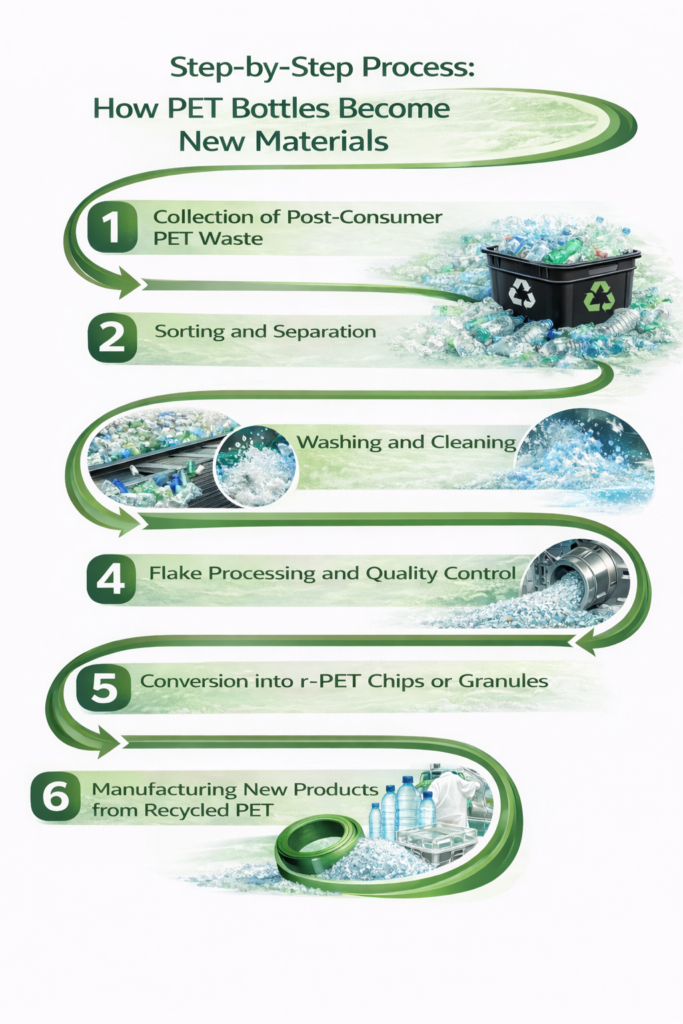
1. Collection of Post-Consumer PET Waste
The process begins with collecting used PET bottles from municipal systems, deposit schemes, and commercial waste streams.
Why this step matters:
The quality of recycled PET depends heavily on the purity and consistency of collected material. Mixed plastics or contaminants increase processing costs and reduce output performance.
2. Sorting and Separation
Collected waste undergoes automated and manual sorting to separate PET from other plastics, metals, labels, and non-recyclable materials.
Sorting methods include:
- Near-infrared (NIR) optical scanning
- Density-based separation
- Magnetic metal removal
- Manual quality checks
Clear, green, and colored PET bottles may also be separated to maintain color consistency in the final recycled product.
3. Washing and Cleaning
PET bottles are shredded into flakes and washed using hot water, detergents, and friction washers to remove:
- Food residue
- Adhesives
- Labels
- Oils
- Dirt
Effective cleaning prevents polymer degradation, ensuring the recycled resin meets food-grade or industrial-grade standards, depending on its intended use.
4. Flake Processing and Quality Control
Clean PET flakes undergo screening and drying. Moisture control is critical because PET is hygroscopic, and excess moisture can weaken molecular chains during melting.
Key quality checks include:
- Intrinsic viscosity testing
- Color consistency evaluation
- Contaminant threshold measurement
- Melt flow index testing
Higher-quality flakes lead to stronger, more reliable recycled PET and consistent performance in final products.
5. Conversion into r-PET Chips or Granules
Dried flakes are melted and extruded into uniform pellets or granules. This stage stabilizes polymer structure and prepares the material for downstream applications.
At this stage, r-PET can be tailored for:
- Bottle-to-bottle recycling
- Textile fiber manufacturing
- Sheet and film extrusion
- Strapping and industrial molding
6. Manufacturing New Products from Recycled PET
Recycled PET pellets serve as feedstock for producing a range of new materials:
Common r-PET applications include:
- Beverage bottles and food containers
- Polyester fibers and fabrics
- Packaging films and thermoformed trays
- Automotive components
- Industrial strapping
- Sheets and molded parts
When processed correctly, r-PET retains much of the structural strength, clarity, and barrier performance of virgin PET.
Environmental Benefits of PET Recycling
The cumulative impact of PET recycling delivers measurable environmental gains across the value chain:
- Reduced landfill waste—Millions of bottles are diverted from dumping grounds and oceans.
- Lower carbon footprint—rPET production consumes significantly less energy than virgin PET.
- Conservation of natural resources—Reduces dependence on crude oil and natural gas.
- Support for circular economy—Materials are reused repeatedly instead of being discarded after one use.
Key Performance Characteristics of Recycled PET
Recycled PET is increasingly adopted because it delivers functional reliability without compromising material performance.
Typical properties include:
- High tensile strength
- Good impact resistance
- Stable thermal performance
- Strong gas and moisture barrier behavior
- Lightweight with a favorable strength-to-weight ratio
- Compatibility with multi-cycle recycling when properly managed
For many applications, r-PET provides a strong balance of durability, efficiency, and sustainability.
Why Businesses Are Transitioning to r-PET
The shift toward recycled PET is driven by regulatory, operational, and supply chain priorities, rather than sustainability alone.
Business drivers include:
- Regulatory compliance with global packaging
- Supply chain diversification away from virgin resin volatility
- Cost and volatility control in fluctuating resin markets
- Brand commitments to circular economy models
- Consumer preference for recycled content
r-PET enables companies to reduce environmental impact while maintaining quality, cost control, and regulatory alignment.
Conclusion
Recycling PET bottles into new materials is not a symbolic sustainability effort—it is a technically proven, economically viable, and scalable material solution. When managed with proper process controls, r-PET delivers reliable performance, regulatory alignment, and long-term resource efficiency.
For manufacturers and packaging decision-makers, understanding the technical flow of PET recycling enables smarter sourcing, reduced operational risk, and stronger sustainability outcomes.
Tapadia Polyester continues to advance high-performance recycled PET solutions through disciplined material science, controlled processing, and consistent quality standards.
Contact us today to evaluate r-PET solutions that support confident, compliant, and future-ready production decisions.
Frequently Asked Questions (FAQs)
Yes. With controlled processing and quality screening, r-PET can deliver comparable mechanical strength and thermal stability for many applications.
PET can typically be recycled multiple times, although polymer chains gradually shorten. Additives and reprocessing controls help extend material usability.
Costs vary by market conditions, but r-PET often provides long-term cost efficiency, particularly during periods of virgin resin price volatility.
Key factors include:
- Input material purity
- Cleaning effectiveness
- Moisture control
- Processing temperature stability
- Final pellet testing standards
Yes. Recycling PET typically reduces carbon emissions, energy use, and landfill dependency compared to virgin resin production.