Polyester film is one of the most widely used materials across packaging, electronics, graphics, and industrial applications. Known for its strength, clarity, and thermal stability, it delivers reliable performance; however, choosing the right polyester film is essential to achieve the best results for your product.
This guide highlights the key factors to help you choose the right polyester film for your application.
What Is Polyester Film?
Polyester film is made from polyethylene terephthalate (PET) and is valued for its balance of mechanical strength, flexibility, chemical resistance, and dimensional stability.
Common applications include:
- Flexible packaging
- Electrical insulation
- Printing and graphics
- Industrial processing
- Labels and security applications
Its adaptability makes polyester film suitable for both everyday packaging and technically demanding industrial applications.
Why Polyester Film Is So Widely Used
Polyester film is widely adopted because it offers a consistent balance of physical, thermal, and functional properties:
- Mechanical strength: Resists tearing, stretching, and impact
- Thermal stability: Performs well across a wide temperature range
- Chemical & moisture resistance: Suitable for demanding environments
- Electrical performance: Reliable dielectric properties for electronics
- Printability & clarity: Smooth surface for graphics and branding
These characteristics make polyester film suitable for both packaging and industrial uses.
Step-by-Step Guide to Choosing the Right Polyester Film
Step 1: Define Your Product Requirements
Start by understanding how and where the film will be used.
Ask yourself:
- Which industry is this for (food, pharma, FMCG, industrial)?
- Is printing or lamination required?
- Are barrier properties critical?
- Will the product face heat, moisture, or mechanical stress?
- Are sustainability goals important?
Clear answers will significantly narrow down the suitable film options.
Step 2: Determine the Required Film Thickness (Micron)
Film thickness (micron) directly affects strength, stiffness, cost, and machine handling, making correct selection essential for balanced performance and cost.
Typical Micron (µm) Guidelines:
| Micron Range | Common Applications | Key Performance Driver |
|---|---|---|
| 8 – 12 µm | Flexible packaging lamination | Flexibility, cost-efficiency |
| 25 – 50 µm | Labels, printing, and general industrial use | Balance of strength and printability |
| 75 – 125 µm | Electrical insulation, motor slot liners | Dielectric strength, durability |
| 150 – 350 µm | Heavy-duty industrial applications | Maximum stiffness and tear resistance |
Step 3: Quantify Barrier Performance Requirements
Polyester films offer basic moisture resistance, but metallized or coated structures are needed for high-barrier performance. OTR and WVTR should align with product sensitivity and shelf-life goals.
- Oxygen Transmission Rate (OTR): The rate at which oxygen gas passes through the film.
- Water Vapor Transmission Rate (WVTR): The rate at which water vapor passes through the film.
Polyester films offer basic moisture resistance, but metallized or coated structures are needed for high-barrier performance. OTR and WVTR should align with product sensitivity and shelf-life goals.
Step 4: Evaluate Thermal and Mechanical Performance
The film must withstand both the end-use environment and the rigors of the manufacturing process.
- Thermal Evaluation: Consider the film’s dimensional stability under temperature fluctuations and its heat resistance during sealing or processing (e.g., retort or hot-fill applications).
- Mechanical Evaluation: Key metrics include Tensile Strength (resistance to pulling apart), Tear Resistance (resistance to propagation of a tear), and Puncture Resistance (resistance to sharp objects). Demanding applications require a film with a highly balanced mechanical profile.
Step 5: Finalize Surface Treatment and Conversion Compatibility
If the film requires printing or lamination, the surface energy must be sufficient.
- Printing: A Corona-treated film is typically necessary to ensure strong ink adhesion and consistent print quality.
- Conversion: Ensure the film is compatible with downstream processes such as slitting, coating, and lamination. For example, a film intended for lamination must have a surface that bonds effectively with the chosen adhesive.
Step 6: Select a Strategic Supplier
The film’s performance is only as reliable as its source. A strategic supplier offers more than just material; they provide a technical partnership.
- Technical Support: Access to R&D and application engineers to assist with material selection and troubleshooting.
- Consistency and Quality: Certified quality systems (e.g., ISO standards) and tight thickness control are essential for high-speed, high-yield manufacturing lines.
- Customization: The ability to tailor film properties (coatings, thickness, treatments) for unique application needs.
Common Application Examples
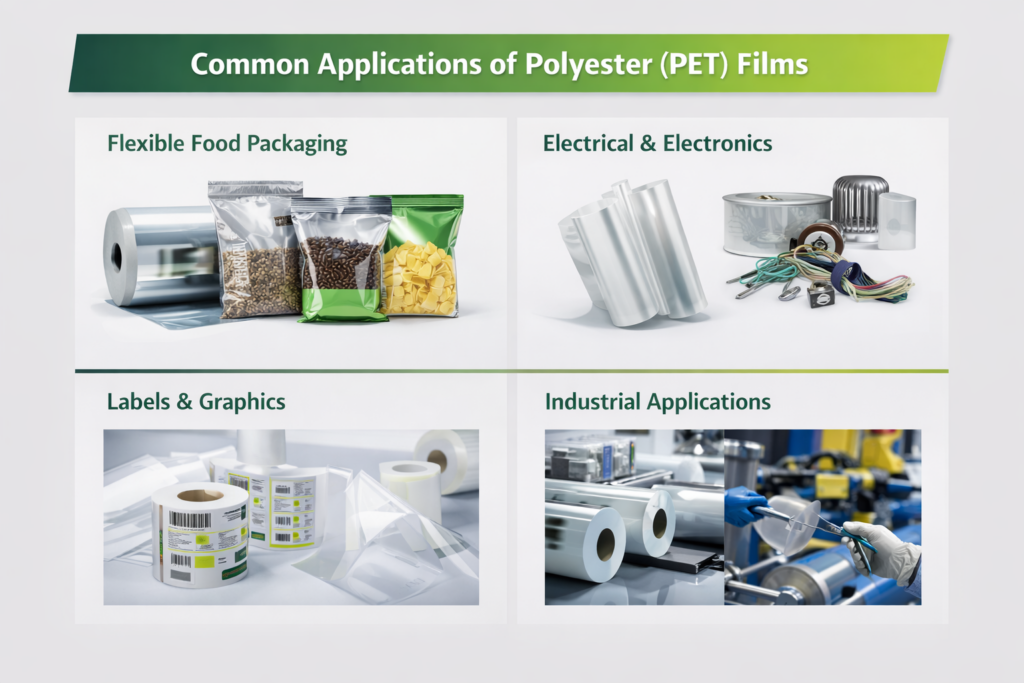
Flexible Food Packaging
- Metallized polyester for barrier enhancement
- Coated PET for improved sealability
- FDA-compliant, clear PET for transparency
Electrical Insulation & Electronics
- Electrical-grade PET films
- Coated insulation films
Labels and Graphics
- Treated or coated polyester for superior ink adhesion
- Clear or opaque PET, depending on aesthetics
Industrial Applications
- High-tensile strength PET
- Chemically resistant coated films
Sustainability & rPET Films
Sustainability is increasingly important in packaging decisions. rPET polyester films help reduce environmental impact while maintaining high performance.
Benefits include:
- Lower carbon footprint
- Compatibility with recycling streams
- Support for circular economy goals
Tapadia Polyester integrates sustainability across its manufacturing processes.
Conclusion
Choosing the right polyester film is a strategic decision that impacts performance, appearance, processing efficiency, and sustainability. By understanding your application needs, evaluating technical properties, and working with a trusted supplier, you can confidently select a film that delivers long-term value.
Contact Tapadia Polyester to find the polyester film solution that fits your application—where innovation meets responsibility.
Frequently Asked Questions (FAQs)
Polyester film offers superior strength, thermal stability, and chemical resistance compared to many other plastic films.
Thickness depends on strength, flexibility, durability, and processing requirements.
Yes, polyester film performs well across a wide temperature range.
Yes. Thickness, coatings, and surface treatments can be tailored.
Polyester film is recyclable, and rPET options further reduce environmental impact.